
Frequently Asked Questions About Custom Matting
The primary difference lies in the chemical composition. Standard paper mats often contain lignin, which turns acidic over time and causes “mat burn” (yellowing) on your artwork. At Framagraphic, we use acid-free and lignin-free alpha-cellulose or 100% cotton rag mats. These are pH-neutral, ensuring your art remains preserved and discoloration-free for decades.
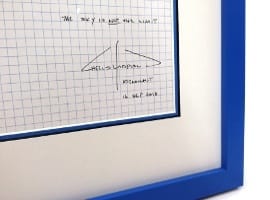
Typically, a mat opening is cut 1/8″ to 1/4″ smaller than the dimensions of your image. This overlap is necessary to secure the artwork to the back of the mat and prevent the edges from peeking through. If you wish to see the entire image or a signature at the bottom, we recommend a “weighted” bottom or a float mount.
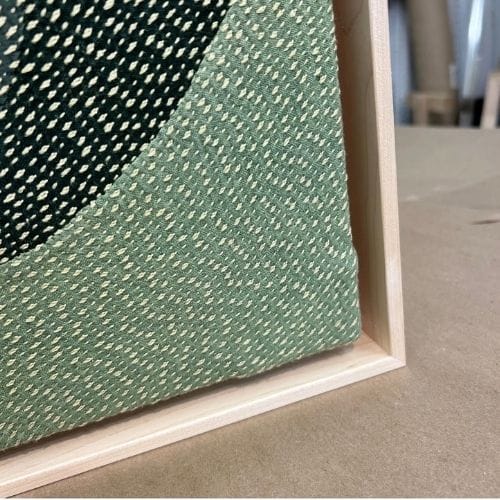
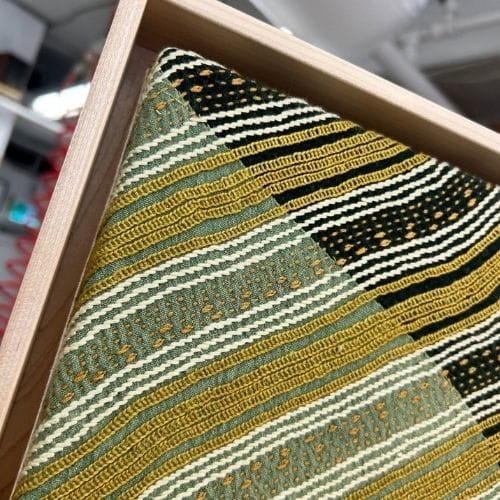
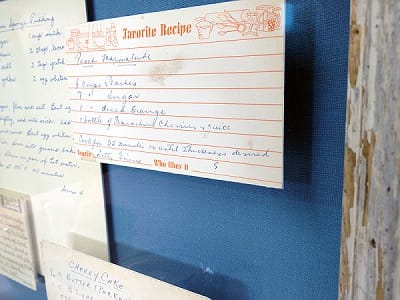
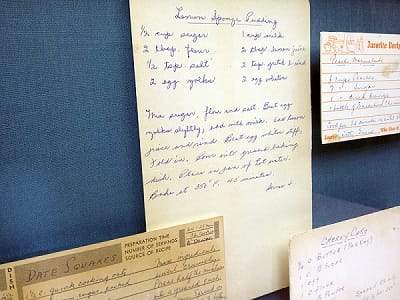
Float mounting is ideal for artwork with deckled (hand-torn) edges, or pieces where the artist’s signature or important details go right to the edge of the paper. It is also a popular choice for 3D textiles, thick heavy-weight paper, or historic documents where you want to showcase the physical object in its entirety rather than hiding the edges behind a mat window.
No. When we perform a raised float or use raised matting, we install frame spacers (hidden plastic or wood strips) along the inside edge of the frame. This creates a safe air gap between the glass (glazing) and the artwork. This is critical for preventing moisture trapped in the air from causing the art to stick to the glass, which can lead to mold or permanent damage.
A triple mat adds significant visual depth and is often used to create a “tunnel” effect that draws the eye into the piece. It allows for more complex color play. For example, using two neutral outer mats with a very thin, vibrant “middle” mat that picks up a specific color in the artwork. It also creates a thicker physical barrier, which provides a high-end, gallery-quality aesthetic.
Dry mounting is a process that uses heat and pressure to flatten an image permanently against a backing board. While great for posters or photographs that tend to ripple, we do not recommend dry mounting for original art, limited editions, or high-value items, as the process is usually irreversible and can decrease the artwork’s value. For those pieces, we use archival hinging or corner pockets.